Getting your USCG captains license in Florida is required for operating charter fishing boats, tour vessels, or commercial passenger boats throughout Florida’s extensive waterways—from the Florida Keys to Tampa Bay, Miami to Jacksonville, and the Gulf Coast to the Atlantic. This comprehensive guide covers OUPV 6-pack and Master license requirements, costs ($1,070-$2,045), exam preparation, Florida FWC permits, and Miami REC application procedures.
Table of Contents
- What is a Captains License in florida
- Types of Captain's Licenses
- OUPV 6-Pack License
- Master License (25/50/100/200 Ton) & Upgrades
- License Renewals
- Florida State-Specific Requirements
- Comparison Table (Captains license in florida)
- Florida Training Providers
- Frequently Asked Questions
- Can I use recreational boating time in Florida for sea service?
- Do I need a captain's license for a private boat in Florida?
- What's the difference between OUPV and Master license?
- Which license do I need for charter fishing in the Florida Keys?
- How much does a captain's license cost in Florida?
- Where do I take the captain's license exam in Florida?
- Can I operate in the Florida Keys with an Inland license?
- What happens if my license expires in Florida?
- Do I need FWC permits in addition to my USCG license?
- Can non-U.S. citizens get a captain's license in Florida?
- What about operating in Everglades National Park?
- Key Considerations for Florida Captains
- Florida Maritime Environment Considerations
- Contact Information
- Final Recommendations
What is a Captains License in florida
A USCG captain’s license in Florida is federally mandated for anyone carrying paying passengers on charter boats, tour vessels, or commercial fishing operations. Whether operating in the Florida Keys, Tampa Bay, Miami waters, Jacksonville coastal areas, or offshore Gulf and Atlantic routes, this credential proves seamanship, safety knowledge, and legal compliance with both federal USCG and Florida state regulations.
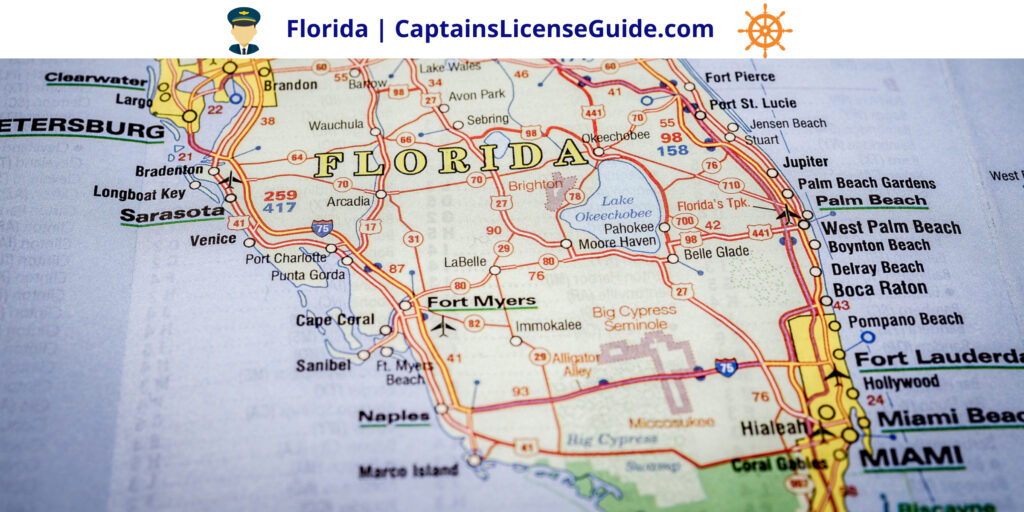
Why You Need a Captain’s License in Florida:
- Required for all for-hire passenger operations statewide
- Charter fishing boats in Florida waters (saltwater and offshore)
- Tour and sightseeing vessels (Everglades, Keys, coastal tours)
- Water taxi and shuttle services
- Dive charter operations
- Commercial vessel operations throughout Florida
Florida’s Unique Maritime Environment:
- 1,350 miles of coastline (more than any contiguous state except Alaska)
- Access to Atlantic Ocean, Gulf of Mexico, and Intracoastal Waterway
- Florida Keys offshore fishing charters
- Tampa Bay commercial operations
- Miami cruise port operations
- Extensive inland waterway system
Types of Captain’s Licenses
Available License Types:
- OUPV (Operator of Uninspected Passenger Vessels) – “6-Pack License”
- Master 25 Ton – Small commercial vessels
- Master 50 Ton – Medium charter operations
- Master 100 Ton – Large vessels and ferries
- Master 200 Ton – Commercial and offshore operations
- Upgrades – OUPV to Master progression
- Renewals – Every 5 years
OUPV 6-Pack License
The OUPV license Florida (commonly called a “6-pack license”) allows you to carry up to 6 paying passengers on uninspected vessels up to 100 gross tons in Florida waters and beyond.
OUPV Eligibility Requirements
Basic Requirements:
- Age: Minimum 18 years old
- Sea Service: 360 days on water since age 16; 90 days in past 3 years
- Near Coastal Route: Requires 90 days on ocean/coastal waters (recommended for Florida)
- TWIC Card: Transportation Worker Identification Credential required- TWIC CARD
- Medical Exam: Form CG-719K by USCG-approved physician
- Drug Testing: DOT 5-panel urinalysis (within 6 months)
- CPR & First Aid: Current certification within 12 months (Red Cross or USCG-approved)
- Citizenship: U.S. citizen or legal permanent resident (non-citizens can obtain OUPV with Green Card)
Sea Service Documentation for Florida Waters:
- Each qualifying day = minimum 4 hours on water; full day = 8+ hours
- Maintain detailed logbooks: vessel name, dates, owner contact, activity
- Recreational boating in Florida waters counts when properly documented
- Owner or licensed captain must sign CG-719S sea service forms
- Keep records of all time on Florida waters (Keys, Gulf, Atlantic, Intracoastal)
- Offshore fishing experience beyond Florida territorial waters counts toward Near Coastal
Limited OUPV Option:
- 120-day sea service minimum for limited operations
- Restricted to specific geographic areas
- Less common for Florida charter operations
OUPV Education and Exam
Training Options in Florida:
- USCG-approved classroom courses (Miami, Tampa, Orlando, Jacksonville, Fort Lauderdale, Naples, Key West)
- Blended online/in-person programs
- Fully online with proctored exams at Miami REC or approved schools
- On-the-water practical training (available at select Florida schools)
Exam Modules and Passing Scores:
- Rules of the Road: 90% required
- Navigation General: 70% required
- Chart Plotting: 90% required (using Florida charts)
- Deck General/Safety: 70% required
Exam Preparation for Florida Operators:
- All USCG-approved schools provide complete study materials
- Practice tests available through Florida training providers
- Chart plotting requires hands-on practice with parallel rulers and dividers
- Failed modules can be retaken individually
- Passing scores remain valid for 1 year
- Florida waters knowledge beneficial (Gulf Stream, Keys channels, Intracoastal navigation)
- Understanding Florida-specific hazards (hurricanes, weather patterns, shallow waters)
OUPV Documentation Required
Complete Application Package:
- Sea service forms (CG-719S) with vessel details
- TWIC card (apply at multiple Florida locations)
- Application form (CG-719B)
- Medical examination (CG-719K)
- DOT drug test results
- CPR/First Aid certification
- Proof of U.S. citizenship or permanent residency (Green Card acceptable for OUPV)
OUPV Application Process
Step-by-Step:
- Gather all required documentation
- Complete application and sea service forms
- Register for USCG-approved course and exam (strongly recommended)
- Pay USCG evaluation fees (~$145)
- Submit package to National Maritime Center or Miami REC
Processing Timeline:
- Application review: 4-8 weeks typical
- No expedited processing for initial applications
- Check status at NMC website using application number
- License valid immediately upon issuance by USCG
- Miami REC can answer Florida-specific questions
Florida-Specific Application Tips:
- Apply at Miami REC (51 S.W. 1st Ave, 6th Floor, Miami, FL 33130)
- Email applications to MMCApplications@uscg.mil
- Medical forms separate: medaip@uscg.mil
- Keep PDF submissions under 15MB
- Many Florida schools assist with application compilation
OUPV Total Cost Breakdown
| Line Item | Cost Range |
|---|---|
| USCG-Approved Course Florida | $600–$1,495 |
| USCG Evaluation Fees | ~$145 |
| TWIC Card | $125 |
| Medical Exam | $100–$150 |
| Drug Test | $50–$100 |
| CPR/First Aid | $50–$130 |
| Total Investment | $1,070–$2,045 |
Costs for Florida training providers vary by location and course format. Blended courses (online + in-person) typically fall mid-range.
Master License (25/50/100/200 Ton) & Upgrades
Master licenses allow operation of inspected passenger vessels with unlimited passengers (up to vessel certificate) and command of crew members. Essential for Florida ferry operations, large charter boats, dive boats with 7+ passengers, and commercial vessels.
Master License Eligibility
Age and General Requirements:
- Age: Minimum 19 years old
- Citizenship: Must be U.S. citizen (Green Card holders cannot obtain Master license)
- TWIC/Medical/Drug/CPR: Same as OUPV requirements
Sea Service by License Level:
- 25-Ton Master: 360 days total (any vessel size); 90 days in last 3 years
- 50-Ton Master: Requires 90 days on vessels ≥26 GRT (Gross Register Tons)
- 100-Ton Master (Inland/Great Lakes): Requires 180 days on vessels ≥34 GRT
- 100-Ton Master (Near Coastal): 720 days total (360 on near coastal waters); 90 in last 3 years
- 200-Ton Master: 720+ days with substantial time on large vessels
Understanding Tonnage Requirements:
- GRT (Gross Register Tons) = internal volume calculation (100 cubic feet = 1 GRT)
- GRT ≠ vessel length or displacement weight
- Verify vessel GRT from documentation or registration
- Many Florida charter boats fall in 26-65 GRT range
- Large dive boats and ferries require 50-100 ton credentials
- 100-ton vessel typically 65+ feet in length
Route Endorsements for Florida Waters:
- Inland: Rivers, bays, sounds (Tampa Bay, Biscayne Bay, Indian River Lagoon, Intracoastal Waterway)
- Great Lakes: Five Great Lakes and connecting waters (less relevant for Florida)
- Near Coastal: Within 200 miles of shore (most Florida offshore charter operations, Keys fishing, Gulf operations)
- Oceans: Unlimited worldwide (requires extensive offshore service)
Recommended for Florida Operators:
- Near Coastal endorsement essential for offshore fishing, Keys operations, Gulf Stream access
- Inland-only restricts operations to protected Florida waters
Master License Education and Exam
Training Requirements:
- USCG-approved upgrade courses mandatory (available throughout Florida)
- Online options with proctored exams at Miami REC or approved schools
- Advanced course material beyond OUPV level
- Many Florida schools offer weekend or evening options for working captains
Exam Modules:
- Advanced Deck General & Safety
- Vessel Inspection procedures
- Advanced Navigation/Chartplotting (Florida charts)
- Rules of the Road (comprehensive)
- Radar Observer certification (required for some upgrades)
Master License Benefits in Florida:
- Operate Coast Guard inspected passenger vessels
- Carry unlimited passengers (per vessel certificate)
- Command licensed and unlicensed crew members
- Required for Florida dive boats with 7+ passengers
- Required for ferry operations (Tampa, Miami, Fort Lauderdale)
- Higher earning potential in Florida charter and commercial sectors
- Access to cruise ship tender operations
- Expanded job opportunities in Florida’s tourism and maritime industry
Master License Documentation
Required for Application/Upgrade:
- Detailed sea service forms with vessel tonnage and routes
- Proof of USCG-approved course completion
- Current medical examination (CG-719K)
- Recent drug test results
- CPR/First Aid certification
- Valid TWIC card
- Proof of U.S. citizenship (required for Master, Green Card not accepted)
Master License Application Process
Upgrade Steps:
- Document all qualifying vessel service with GRT and routes
- Enroll in and complete USCG-approved upgrade course
- Compile all medical, testing, CPR, and TWIC documentation
- Pay USCG fees ($145 base; additional for route endorsements)
- Submit complete package to National Maritime Center or Miami REC
Master License Upgrade Costs
| Line Item | Cost Range |
|---|---|
| Master Upgrade Course | $400–$995 |
| USCG Evaluation Fees | $145+ |
| Medical/Drug/CPR/TWIC | Same as OUPV |
| Total Upgrade Investment | $1,000–$1,400 |
Additional costs if adding multiple route endorsements or tonnage increases.
License Renewals
USCG captain’s licenses in Florida must be renewed every 5 years to remain valid for charter and commercial operations.
Renewal Requirements
Mandatory Elements:
- Renewal Interval: Every 5 years from issue date
- Sea Service: 360 days in last 5 years (or must retest)
- Medical Exam: Current CG-719K form
- Drug Test: Recent DOT 5-panel results
- CPR/First Aid: Current certification
- TWIC Card: Must remain valid throughout license period
- Application: Submit new CG-719B with renewal package
Renewal Streamlining Strategy:
- Begin renewal process 8-12 months before expiration
- TWIC renewal alone takes 4-6 weeks; start early
- Multiple TWIC locations throughout Florida for convenience
- Medical exams valid only 12 months for renewal purposes
- Many Florida schools offer 1-2 day renewal courses
- Renewal courses satisfy retest requirement if sea service insufficient
Renewal Application Process
Submission:
- Complete package to National Maritime Center via mail or email
- Processing time: 3-8 weeks typical
- Miami REC can assist with Florida-specific questions
- Do not let license lapse; expired license requires full retest
Florida State-Specific Requirements
Beyond the federal USCG captain’s license, Florida requires additional permits and compliance for charter boat operations through the Florida Fish and Wildlife Conservation Commission (FWC).
Required Florida FWC Permits
FWC Charter Captain License:
- Required for saltwater fishing guide operations in Florida
- Allows captain to operate multiple vessels
- Purchase at Florida tax collector offices statewide
- Cannot be purchased online
- Requires valid USCG captain’s license
- Annual renewal required
- Contact: FWC (850) 487-3122
FWC Charter Boat License:
- Required for specific vessel used in charter operations
- Covers passengers fishing under vessel license
- Passengers do not need individual recreational fishing licenses
- Specifies number of fishing passengers allowed
- Must match or be less than USCG passenger capacity
- Purchase at Florida tax collector offices
- Annual renewal required
Saltwater For-Hire Fishing Requirements:
- Charter captain OR charter boat license required (not both)
- Charter Captain License: Captain can move between boats
- Charter Boat License: Tied to specific vessel
- Covers passengers for saltwater fishing only
- Does not cover freshwater fishing guides (different requirements)
- Does not cover sightseeing or diving charters (no FWC fishing license needed)
Important Florida FWC Distinctions:
- FWC charter license separate from USCG captain’s license
- USCG license alone insufficient for Florida saltwater charter fishing
- Dive charters: FWC license not required unless passengers fishing
- Sightseeing tours: FWC charter license not required
- Must have USCG license first, then apply for FWC permits
Florida Vessel and Operational Compliance
Vessel Registration:
- All Florida charter vessels must be registered with Florida DHSMV
- Unless federally documented (USCG documentation)
- Registration includes vessel capacity determination
- Annual registration renewal required
Federal Permits for Florida Waters:
- Gulf of Mexico federal waters (beyond 9 nautical miles): Federal charter/headboat permit required for certain species
- Atlantic federal waters (beyond 3 nautical miles): Federal permits may be required
- Reef fish, highly migratory species, and other federally managed species require specific permits
- Check with NOAA Fisheries for current federal permit requirements
Additional Florida Requirements:
- Insurance: Liability coverage strongly recommended (minimum $300,000)
- Local Occupational Licenses: Check with city/county where operating
- National Park Permits: Everglades National Park, Biscayne National Park, Dry Tortugas require special permits
- Florida Keys National Marine Sanctuary: Compliance with sanctuary regulations
- Environmental Regulations: Discharge, waste, and protected species compliance
- Captain and Crew Bag Limits: Florida has specific restrictions on captain/crew keeping fish under charter license
Florida Boating Safety Requirements:
- All boat operators born on or after January 1, 1988, operating vessel with 10+ HP must complete Florida Boating Safety Course
- Obtain Florida Boating Safety ID Card
- Card does not expire
- Available through FWC-approved providers
Comparison Table (Captains license in florida)
| License Type | Age | Citizenship | Sea Service | Max Passengers | Vessel Type | Tonnage | Route Options | Typical Florida Use |
|---|---|---|---|---|---|---|---|---|
| OUPV 6-Pack | 18 | US/Green Card | 360 days | 6 | Uninspected | ≤100 | Inland/Coastal/GL | Keys fishing, inshore charters, eco-tours |
| Master 25 | 19 | US Citizen | 360 days | Unlimited* | Inspected/Uninspected | ≤25 | Various | Small tour boats, water taxi |
| Master 50 | 19 | US Citizen | 90-180 days ≥26 GRT | Unlimited* | Inspected/Uninspected | ≤50 | Various | Dive boats, medium charters |
| Master 100 | 19 | US Citizen | 180 days ≥34 GRT | Unlimited* | Inspected/Uninspected | ≤100 | Various | Large dive boats, party boats, ferries |
| Master 200 | 19+ | US Citizen | 720+ days large vessel | Unlimited* | Inspected/Uninspected | ≤200 | Various | Commercial ferries, large offshore ops |
Unlimited passengers per vessel’s Coast Guard certificate of inspection
Florida Training Providers
Southwest Florida Training Options
The Captain School (Cape Coral, Naples, Venice)
- Locations: Cape Coral, Naples, Venice
- USCG-approved OUPV and Master courses
- Smaller class sizes, personalized instruction
- 30+ years experience
- Website: https://captainschool.com
- Course Cost: $850 + $95-100 testing fee
Safe Passage Maritime (Pensacola, Punta Gorda)
- USCG-approved licensing and endorsements
- Sailing programs available
- Weekend and evening options
Southeast Florida Training Options
Captain School Miami (Coconut Grove)
- Location: Coconut Grove, Miami
- Blended learning programs available
- Online + classroom + on-water training
- STCW certification courses
- Website: https://captainschoolmiami.com
Maritime Professional Training – MPT (Fort Lauderdale)
- Comprehensive USCG, MCA, RYA, STCW training
- No test at Coast Guard (school proctored)
- 8-11 day programs
- Work with students until they pass
- International certification programs
- Website: https://www.mptusa.com
Chapman School of Seamanship (Stuart)
- Professional marine training
- Complete yacht and powerboat certification
- Historic maritime education institution
- Comprehensive programs
- Website: https://chapman.org
Florida Keys Training Options
Captain School Key West
- Location: Key West
- Blended learning (online + classroom + on-water)
- 3-day intensive option available
- Keys-specific navigation training
- Website: https://captainschoolkeywest.com
Boy Scouts Sea Base (Florida Keys)
- OUPV and Master training
- Sailing and towing endorsements
- Hands-on practical training
- Keys location with marina access
- Website: https://seabaseha.org
Central Florida Training Options
Captain School Space Coast (Merritt Island)
- Location: Merritt Island
- USCG-approved programs
- Florida chart training
- Website: https://captainschoolspacecoast.com
Florida Keys Community College (Key West)
- Marine engineering and seamanship programs
- Management education
- Licensing programs
Tampa Bay / Gulf Coast Training Options
MTC Maritime Training Center (Tampa)
- Location: Tampa near port
- USCG-approved OUPV and Master courses
- STCW endorsements
- Professional, experienced instructors
- Nearly flawless success rate
- Smaller classes with question-friendly environment
- Website: https://www.stcwdirect.com/schools/117/mtc-maritime-training-center/
Quality Maritime Training – QMT (Jacksonville, Tampa)
- Established 2005
- USCG-approved and STCW training
- Multiple Florida locations
Gulf Coast Maritime Academy – GCMA (Tampa)
- Tampa-based training
- Multiple maritime programs
North Florida Training Options
Sea School (St. Petersburg, Jacksonville, Panama City, Fort Lauderdale)
- Headquarters: St. Petersburg
- Multiple Florida locations
- USCG-approved maritime training
- Online courses available
- Premier maritime training reputation
- Website: https://www.seaschool.com
Conidae Marine (Jacksonville)
- Jacksonville area training
- USCG-approved programs
Safe Passage Maritime (Pensacola)
- Panhandle location
- USCG licensing courses
Maritime Institute of Technology (Panama City)
- Panhandle Gulf Coast location
- Professional maritime training
Online Training Options (Florida Testing Available)
Mariners Learning System
- Comprehensive online courses
- Proctored exams at Miami REC or approved locations
- Recognized by USCG
- Certificate valid 1 year for application
- Website: https://marinerslearningsystem.com
Online Captain School
- Online arm of Captain School Key West
- Blended options available
- Florida testing locations
Marine Education Solutions
- Membership-based online training
- Question pools and practice exams
- Florida-based company
Selecting a Florida Training Provider
Evaluation Criteria:
- USCG approval verification (check National Maritime Center website)
- First-time exam pass rates
- Instructor experience in Florida waters (Keys, Gulf, Atlantic)
- Course schedule flexibility (weekday, weekend, evening options)
- Exam proctoring location (Miami REC accessibility or school testing)
- Cost comparison for identical credentials
- On-the-water training availability
- Reviews from Florida charter captains
- Blended learning options (online + in-person)
- Assistance with application compilation
Florida-Specific Considerations:
- Schools near Miami REC offer convenient testing
- Keys-based schools provide unique Florida waters experience
- Tampa/Gulf Coast schools understand Gulf operations
- Multiple locations beneficial for working captains
- Blended programs accommodate seasonal charter schedules
Frequently Asked Questions
How long does it take to get a captain’s license in Florida?
Complete timeline: 3-6 months. Course completion takes 1-2 weeks (or 3 days for intensive blended programs); USCG application processing takes 4-8 weeks. Start gathering sea service documentation and scheduling TWIC appointment immediately.
Can I use recreational boating time in Florida for sea service?
Yes. Recreational boating in Florida waters counts toward the 360-day requirement if properly documented with vessel details, dates, and owner signatures on CG-719S forms. Offshore fishing, Keys cruising, and Intracoastal navigation all qualify.
Do I need a captain’s license for a private boat in Florida?
No. USCG captain’s licenses are only required when carrying paying passengers or operating commercial vessels. Recreational boating requires no federal license. Florida Boating Safety ID Card required for operators born after January 1, 1988, operating vessels with 10+ HP.
What’s the difference between OUPV and Master license?
OUPV (“6-pack”) limits you to 6 passengers on uninspected vessels. Master licenses allow unlimited passengers (per vessel certificate) on inspected vessels and authorize commanding crew members. Master requires U.S. citizenship; OUPV accepts Green Card holders.
Which license do I need for charter fishing in the Florida Keys?
USCG OUPV 6-pack license with Near Coastal endorsement (for offshore fishing). Also required: Florida FWC Charter Captain License OR Charter Boat License (purchased at tax collector offices). Federal permits required for certain species in federal waters.
How much does a captain’s license cost in Florida?
Initial OUPV: $1,070-$2,045 (varies by school and location). Master upgrade: $1,000-$1,400. Costs include training, USCG fees, TWIC, medical exam, drug test, and CPR/First Aid certification. Florida schools range $600-$1,495 for OUPV courses.
Where do I take the captain’s license exam in Florida?
Exams at USCG REC Miami (51 S.W. 1st Ave, 6th Floor, Miami, FL 33130) or through USCG-approved training schools offering proctored testing throughout Florida (Tampa, Jacksonville, Fort Lauderdale, Naples, Key West, Cape Coral, etc.).
Can I operate in the Florida Keys with an Inland license?
No. Florida Keys offshore operations require Near Coastal endorsement. Inland restricts you to protected waters (bays, rivers, Intracoastal). Keys charter fishing and offshore operations require Near Coastal to operate beyond boundary lines.
What happens if my license expires in Florida?
Expired licenses require complete retest of all exam modules. Renew before expiration to avoid retesting. Processing takes 3-8 weeks; start renewal process early, especially during peak Florida charter season (winter/spring).
Do I need FWC permits in addition to my USCG license?
Yes, for saltwater charter fishing. USCG captain’s license alone is insufficient in Florida. Also need FWC Charter Captain License OR Charter Boat License (purchased at tax collector offices). Sightseeing and dive charters (no fishing) do not require FWC permits.
Can non-U.S. citizens get a captain’s license in Florida?
Green Card holders can obtain OUPV license but cannot get Master license (U.S. citizenship required). All applicants need TWIC card regardless of citizenship status.
What about operating in Everglades National Park?
Requires USCG captain’s license plus special permits from National Park Service. Check with Everglades National Park headquarters for specific permitting requirements for for-hire operations.
Key Considerations for Florida Captains
Strategic License Planning
Initial License Selection:
- Start with OUPV 6-pack with Near Coastal endorsement (essential for Florida)
- Inland-only severely restricts Florida charter opportunities
- Near Coastal opens offshore Keys fishing, Gulf operations, Atlantic charters
- Consider future vessel size when documenting sea service
Sea Service Documentation for Florida:
- Document every day on Florida waters from age 16 onward
- Undocumented time cannot be retroactively recovered
- Keep detailed logbooks with vessel GRT for future upgrades
- Verify vessel tonnage from documentation (not length or weight)
- Offshore fishing beyond Florida territorial waters (3-9 nautical miles) counts as Near Coastal
- Gulf Stream experience particularly valuable
Seasonal Considerations:
- Florida charter season varies by region (Keys: year-round; Gulf Coast: spring-fall peak)
- Winter snowbird season increases demand
- Hurricane season (June-November) affects scheduling
- Schedule courses during slower periods
- Account for processing times before peak season
- Renewal timing to avoid high-season expiration
Florida-Specific License Strategy:
- Near Coastal mandatory for most profitable Florida charters
- Master 50-100 ton advantageous for Florida dive boat operations
- Keys operations demand strong navigation skills (channels, shallow waters)
- Gulf Coast operations require weather pattern knowledge
- Atlantic Coast operations benefit from offshore experience
Common Mistakes to Avoid
Documentation Errors:
- Self-signed sea service forms (must be signed by vessel owner or licensed captain)
- Incorrect or missing vessel GRT on forms
- Confusing GRT (Gross Register Tons) with vessel length or displacement
- Insufficient detail on vessel routes and activities
- Not documenting offshore Florida fishing trips properly
Florida Compliance Issues:
- Operating saltwater charter fishing without FWC Charter Captain/Boat License
- Carrying >6 passengers on OUPV license
- Operating on lapsed/expired license
- Missing federal permits for certain species in federal waters
- Captain and crew keeping fish limits under charter license (Florida has specific restrictions)
- Not obtaining National Park permits for Everglades/Biscayne/Dry Tortugas operations
- Violating Florida Keys National Marine Sanctuary regulations
Renewal Problems:
- Insufficient sea service documentation for 5-year renewal
- Expired medical exam at time of renewal submission
- Missing CPR/First Aid certification
- Not starting TWIC renewal early enough (4-6 week process)
- Letting license expire during peak Florida charter season
Florida-Specific Errors:
- Assuming USCG license covers all Florida requirements
- Not purchasing FWC permits at tax collector office
- Confusing Charter Captain vs. Charter Boat license requirements
- Not checking federal water boundaries (9nm Gulf, 3nm Atlantic)
- Operating in protected areas without proper permits
Florida Maritime Environment Considerations
Geographic Operating Areas
Florida Keys:
- Extensive offshore fishing opportunities
- Complex channel navigation (marked channels essential)
- Shallow water operations
- Gulf Stream access from East Coast
- Reef diving charters
- Requires strong navigation skills
Tampa Bay / Gulf Coast:
- Protected bay operations
- Gulf of Mexico offshore access
- Seasonal weather patterns
- Red tide considerations
- Diverse charter operations (fishing, sightseeing, diving)
Southeast Florida / Miami:
- Atlantic Ocean access
- Gulf Stream proximity
- Port operations (Miami, Fort Lauderdale, Palm Beach)
- Cruise ship tender operations
- Dense marine traffic
- Year-round charter opportunities
Northeast Florida / Jacksonville:
- Atlantic Coast operations
- Intracoastal Waterway access
- Seasonal fishing patterns
- River and inland operations
Panhandle / Northwest Florida:
- Gulf of Mexico operations
- Barrier island navigation
- Clear water diving
- Seasonal charter business
Florida Weather and Safety
Hurricane Season:
- June 1 – November 30 official season
- Peak: August-October
- Vessel preparation requirements
- Insurance considerations
- Evacuation plans mandatory
Tropical Weather Patterns:
- Afternoon thunderstorms common (summer)
- Rapid weather changes
- Lightning safety protocols
- Small craft advisories frequent
Marine Life Considerations:
- Protected species (manatees, sea turtles, dolphins)
- Seasonal closures for protection
- Reporting requirements for interactions
- Right whale seasonal area (November-April, Southeast Florida)
Contact Information
Federal USCG Resources
National Maritime Center (NMC)
- Website: https://www.dco.uscg.mil/nmc/
- Phone: 1-888-IASKNMC (1-888-427-5662)
- Email: MMCApplications@uscg.mil (general applications)
- Email: medaip@uscg.mil (medical forms)
- Function: Application processing, credential issuance, general inquiries
USCG REC Miami
- Location: 51 S.W. 1st Ave, 6th Floor, Miami, FL 33130-1608
- Website: https://www.dco.uscg.mil/nmc/recs/miami_florida/
- Function: Local application submission, exam proctoring, Florida-specific guidance
- Appointment only (no walk-ins)
USCG Sector Miami
- Location: 100 MacArthur Causeway, Miami Beach, FL
- Phone: (305) 535-4300
- Website: https://www.atlanticarea.uscg.mil/Our-Organization/District-7/Units/Sector-Miami/
- Function: Vessel inspections, maritime safety, regulatory compliance
TWIC Program (Multiple Florida Locations)
- Website: https://universalenroll.dhs.gov
- Phone: 1-855-347-8371
- Miami Location: 1001 N America Way #111, Miami, FL 33132
- Function: Transportation Worker Identification Credential enrollment
- Multiple enrollment centers throughout Florida
Florida State Resources
Florida Fish and Wildlife Conservation Commission (FWC)
- Website: https://myfwc.com/license/commercial/saltwater/charter/
- General Phone: (850) 487-3122
- License Phone: 1-888-486-8356 (1-888-FISH-FLA)
- Function: FWC Charter Captain License, Charter Boat License, saltwater fishing regulations
FWC License Sales
- Online: GoOutdoorsFlorida.com (recreational only; charter licenses at tax collectors)
- In-Person: Florida tax collector offices statewide (charter licenses)
- Phone: 1-888-FISH-FLORIDA (347-4356)
- Charter licenses CANNOT be purchased online—must visit tax collector
Florida Department of Highway Safety and Motor Vehicles
- Vessel Registration: https://www.flhsmv.gov/
- Boating Safety ID Card information
- Vessel title and registration services
National Park Service (Florida Operations)
- Everglades National Park: (305) 242-7700
- Biscayne National Park: (305) 230-1144
- Dry Tortugas National Park: (305) 242-7700
- Function: Special use permits for for-hire operations in parks
NOAA Fisheries Southeast Regional Office
- Phone: (727) 824-5305
- Website: https://www.fisheries.noaa.gov/region/southeast
- Function: Federal fishing permits, highly migratory species permits
Final Recommendations
For New Florida Captains:
- Obtain OUPV with Near Coastal endorsement (mandatory for most Florida charters)
- Complete Florida FWC Charter Captain License requirements before first saltwater fishing charter
- Budget $1,500-$2,500 for initial licensing, training, and Florida permits
- Choose training provider with strong Florida waters focus
- Document all sea time meticulously from start, especially offshore experience
For License Upgrades:
- Verify vessel GRT requirements before committing to upgrade
- Near Coastal 100-Ton opens most Florida commercial opportunities
- Master 50-100 ton essential for dive boats with 7+ passengers
- Time upgrades during off-season to minimize lost charter revenue
- Ensure sufficient qualifying sea service before enrolling in upgrade course
For Florida Charter Operations:
- USCG license alone insufficient for saltwater fishing charters; obtain FWC permits
- Maintain liability insurance (minimum $300,000 strongly recommended)
- Understand federal water boundaries (9nm Gulf of Mexico, 3nm Atlantic Ocean)
- Stay current on Florida Keys National Marine Sanctuary regulations
- Plan around hurricane season and Florida weather patterns
- Join Florida charter captain associations (FKCFA, etc.) for networking and regulatory updates
- Plan renewals 12 months in advance to avoid peak season disruptions
Florida-Specific Advantages:
- Year-round charter opportunities (especially Keys and South Florida)
- Diverse marine environment (offshore, reef, inshore, rivers, bays)
- Strong tourism industry supports charter businesses
- Multiple training locations throughout state
- Extensive coastline and waterways create numerous opportunities
Success Factors for Florida Charter Captains:
- Strong navigation skills (channels, shallow waters, offshore)
- Weather interpretation (tropical systems, afternoon storms)
- Customer service excellence (competitive Florida market)
- Species identification (diverse Florida marine life)
- Equipment maintenance (saltwater environment demanding)
- Marketing skills (online presence essential)
- Network development (marina relationships, referrals)
This complete guide provides everything needed to obtain, upgrade, or renew your USCG captain’s license in Florida, including all federal requirements and Florida-specific FWC permits for successful charter boat operations throughout Florida’s extensive waterways—from the Keys to the Panhandle, Tampa Bay to Miami, and everywhere in between.