Embarking on a professional maritime career requires more than just time on the water. You must master a unique set of nautical terms to navigate the regulatory landscape effectively. Understanding these specific definitions is a critical step for any mariner aiming to advance their skills.
Whether you are preparing for your initial exam or refreshing your knowledge, having a reliable reference tool makes a significant difference. Our comprehensive uscg captains license glossary provides clear, concise explanations for the complex terminology you will encounter during your studies. You can find additional support and expert study materials by visiting CaptainsLicenseGuide.com to streamline your preparation process.
Mastering this vocabulary ensures you feel confident when you finally sit for your captains license examination. We designed this guide to help you cut through the confusion and focus on what truly matters: your success on the water. Let us help you simplify the path toward your professional goals today.
Navigating the Basics of Your Maritime Career
As you navigate the complexities of a maritime career, it’s essential to grasp the basics that will guide your professional growth. Understanding the foundational elements of your career will not only enhance your knowledge but also boost your confidence as you progress in your profession.
The maritime industry is governed by a set of rules and regulations that are crucial for a successful career. Two fundamental aspects you need to understand are the USCG License Hierarchy and the difference between a boat license and a commercial boat license.
Understanding the USCG License Hierarchy
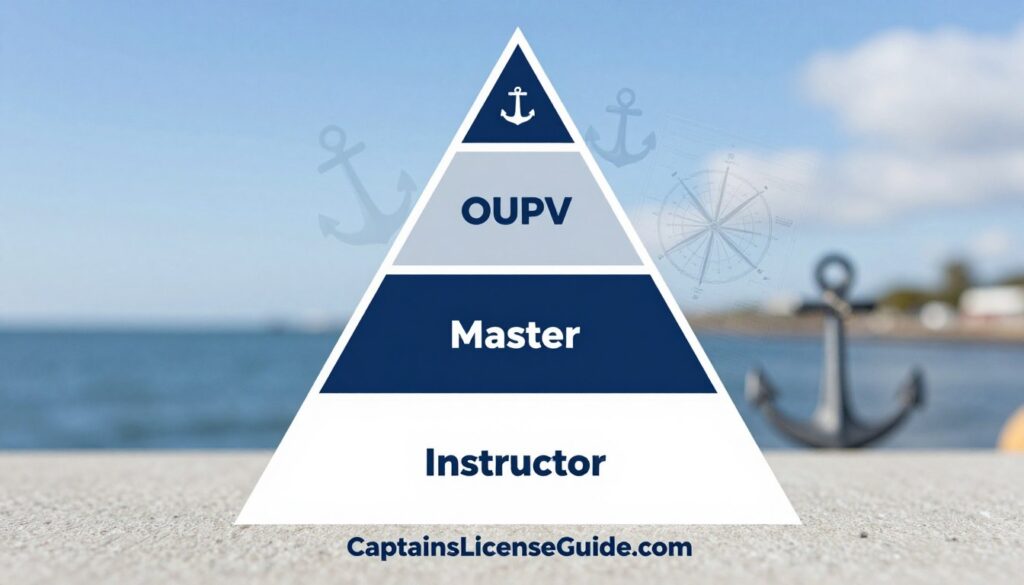
The United States Coast Guard (USCG) issues licenses to mariners based on their qualifications, experience, and the type of vessel they operate. The USCG License Hierarchy is structured to reflect the level of responsibility and the type of vessel a mariner is qualified to operate.
- Operator of Uninspected Passenger Vessels (OUPV): This license is for operators of vessels that carry up to six paying passengers.
- Master or Mate licenses: These licenses are for officers on inspected vessels and have different tonnage and route limitations.
Understanding where you stand in this hierarchy is crucial for advancing your maritime career.
The Difference Between a Boat License and a Commercial License
Many people confuse a boat license with a commercial boat license, but they serve different purposes.
A boat license, often referred to as a recreational boating license, is required for operating a vessel for personal use. On the other hand, a commercial boat license is mandatory for operating a vessel for commercial purposes, such as carrying passengers or cargo for hire.
- Recreational Boating License: Required for personal, non-commercial use.
- Commercial Boat License: Required for commercial operations, such as charter boats or cargo vessels.
Knowing the difference is vital to ensure you’re properly licensed for your specific needs.
Essential Terms for the OUPV Captains License
To navigate the complexities of the OUPV Captains License, it’s essential to familiarize yourself with the fundamental terminology. As you delve into the world of maritime licensing, understanding the specific terms and regulations associated with the OUPV credential is crucial for your success.
Defining the Operator of Uninspected Passenger Vessels
The Operator of Uninspected Passenger Vessels (OUPV) refers to an individual who operates a vessel that carries passengers for hire but is not subject to the inspection requirements that apply to larger, more complex vessels. OUPV vessels are typically smaller and have specific limitations on their operation, including the number of passengers they can carry and the routes they can take.
To be more specific, an OUPV is responsible for operating vessels that:
- Carry up to six paying passengers.
- Are not inspected by the Coast Guard for safety and equipment standards.
- Operate within specific geographic limits, such as inland waters or near-coastal waters.
Understanding Tonnage and Route Limitations
Tonnage and route limitations are critical factors that define the scope of an OUPV’s operation. Tonnage refers to the vessel’s size and capacity, which influences the type of license required. For OUPV operators, understanding these limitations is vital to ensure compliance with maritime regulations.
– Tonnage Limitations: OUPV licenses are generally associated with vessels that are less than 100 gross tons. This limitation is crucial because it determines the type of operations you can conduct.
– Route Limitations: The routes you are allowed to operate on are also defined by your OUPV license. For example, some licenses restrict you to operating in inland waters, while others may allow you to venture into near-coastal or offshore waters.
Mastering Vessel Terminology
As you navigate your maritime career, understanding vessel terminology is crucial. Whether you’re aiming for a USCG license or simply looking to enhance your maritime knowledge, knowing the right terms can make all the difference.
Vessel terminology encompasses a wide range of concepts, from the basic parts of a vessel to the complex regulations governing its operation. To start, let’s break down the essential components of a vessel that every maritime professional should be familiar with.
Key Parts of the Vessel You Must Know
Understanding the different parts of a vessel is fundamental to your maritime education. You should be able to identify and explain the functions of various components, such as the hull, superstructure, propulsion system, and navigation equipment. Each of these elements plays a critical role in the safe and efficient operation of the vessel.
For instance, the hull is the main body of the vessel, providing buoyancy and structural integrity. The superstructure includes any structures above the main deck, such as the bridge or cabins. Familiarity with these terms is not just about passing your USCG license exam; it’s about ensuring you can operate your vessel safely and effectively.
Distinguishing Between Inspected and Uninspected Vessels
Another crucial aspect of vessel terminology involves understanding the difference between inspected and uninspected vessels. Inspected vessels are those that are subject to regular inspections by the USCG to ensure compliance with safety regulations and standards. These vessels typically carry a certain number of passengers or engage in specific types of commercial activities.
On the other hand, uninspected vessels are not subject to the same level of scrutiny. They may be smaller or used for different purposes, such as recreational activities or certain types of commercial fishing. Understanding whether your vessel is inspected or uninspected is vital for complying with USCG regulations and maintaining your USCG license.
By mastering vessel terminology, you’ll be better equipped to navigate the complexities of maritime law, operate your vessel safely, and advance in your maritime career. Whether you’re dealing with inspected or uninspected vessels, knowing the right terms can help you make informed decisions and avoid potential pitfalls.
The Comprehensive USCG Captains License Glossary
The USCG Captains License is not just about passing an exam; it’s about understanding the vast array of terms and definitions that govern your profession. As you prepare for your license, having a comprehensive glossary at your fingertips can be invaluable.
Mastering the terminology of the maritime industry is crucial for effective communication and safe navigation. In this section, we’ll cover the essential terms and acronyms you need to know.
Common Acronyms in the Maritime Industry
The maritime industry is replete with acronyms that can be confusing for newcomers. Understanding these abbreviations is key to navigating the industry with confidence.
- USCG: United States Coast Guard
- OUPV: Operator of Uninspected Passenger Vessels
- TWIC: Transportation Worker Identification Credential
- COLREGs: International Regulations for Preventing Collisions at Sea
These acronyms are fundamental to your understanding of maritime regulations, safety protocols, and professional requirements.
Navigational Terms Every Captain Should Master
Navigational terms are the language of the sea. Familiarizing yourself with these terms is essential for safe and effective navigation.
Some critical navigational terms include:
- Chart Datum: The reference level from which soundings are measured on a nautical chart.
- Leeway: The sideways movement of a vessel due to wind.
- Waypoint: A specific geographic location used for navigation.
Understanding these terms will enhance your ability to navigate safely and efficiently.
By mastering the comprehensive USCG Captains License Glossary, you’ll be better equipped to handle the challenges of your maritime career with confidence.
Rules of the Road and Navigation Definitions
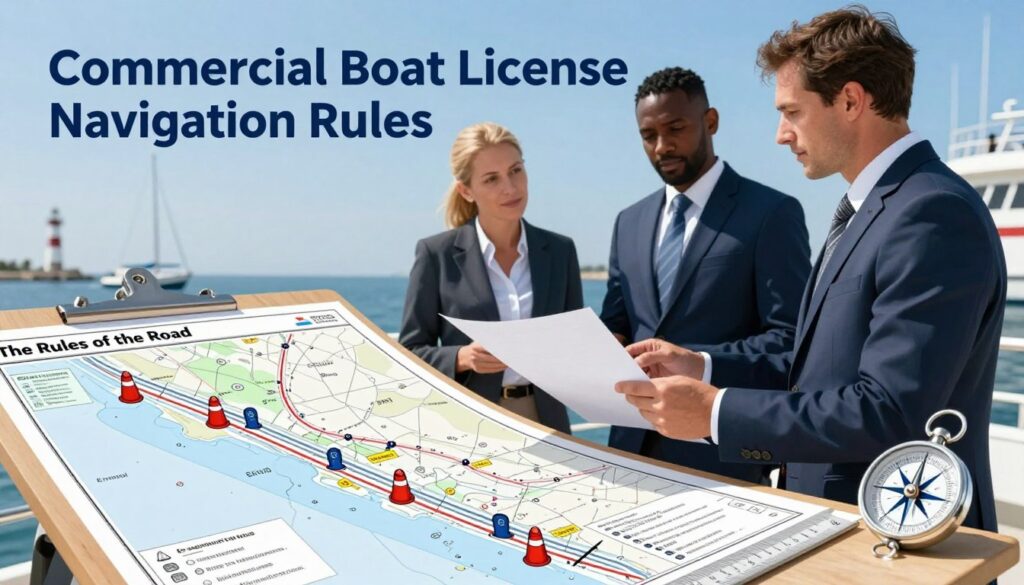
To ensure safe and compliant navigation, grasping the Rules of the Road is essential for any commercial boat license holder. These rules are designed to prevent collisions and ensure that vessels operate safely and efficiently.
The Rules of the Road are comprised of several key components, including COLREGs (Collision Regulations) and Inland Rules. Understanding these regulations is vital for navigating both international and domestic waters.
Understanding COLREGs and Inland Rules
COLREGs are international rules designed to prevent collisions between vessels. They outline the responsibilities of vessel operators and provide guidelines for safe navigation. Inland Rules, on the other hand, apply to vessels operating in the inland waters of the United States.
While both sets of rules share many similarities, there are key differences that you must understand to navigate safely and comply with regulations. For example, COLREGs are used internationally, whereas Inland Rules are specific to U.S. inland waters.
Right of Way and Stand-on Versus Give-way Vessels
Understanding right of way rules is critical for safe navigation. In any encounter between two vessels, one vessel is required to stand on (maintain its course), while the other must give way (alter its course to avoid a collision).
The determination of which vessel is the stand-on vessel and which is the give-way vessel depends on several factors, including the type of vessels involved and their relative positions. For instance, a vessel under sail is generally required to give way to a vessel under power.
To navigate safely, you must be able to determine right of way and act accordingly. This requires a thorough understanding of the Rules of the Road and the ability to apply them in various situations.
Safety and Emergency Response Vocabulary
To ensure you’re well-prepared for any situation on the water, mastering safety and emergency response vocabulary is essential. As you work towards obtaining your boat license, understanding these critical terms will not only enhance your knowledge but also improve your ability to respond effectively in emergency situations.
Standard Distress Signals and Communication
Knowing the standard distress signals and communication protocols is vital for any mariner. Distress signals are used to indicate that a vessel is in a life-threatening situation and requires immediate assistance. Some common distress signals include:
- Mayday calls: Used for life-threatening emergencies.
- Pan-pan calls: Used for urgent situations that are not life-threatening.
- Visual distress signals: Such as flares, flags, and smoke signals.
Effective communication during emergencies is also crucial. You should be familiar with the proper procedures for making distress calls, including the use of radio communication and other signaling devices.
Emergency Equipment Terminology
Understanding the terminology related to emergency equipment is essential for ensuring that you are prepared to handle emergencies on the water. Some key terms include:
- EPIRB (Emergency Position-Indicating Radio Beacon): A device that sends a distress signal to emergency responders in the event of an emergency.
- Life Raft: An inflatable raft designed to provide a safe platform for survivors in the event of a vessel sinking or other emergency.
- Personal Locator Beacon (PLB): A device that sends a distress signal to emergency responders in the event of a personal emergency.
- Fire Extinguisher: A device used to put out fires on a vessel.
Being familiar with these terms and understanding how to use the equipment can significantly enhance your safety on the water.
Documenting Your Sea Service
To successfully apply for a USCG captains license, you must know how to properly document your sea service. This documentation is a critical component of your application, as it verifies your experience and qualifications.
Documenting your sea service is not just about logging your time on the water; it’s about ensuring that your experience is recognized and credited towards your captains license. The USCG has specific requirements for what constitutes creditable sea service.
What Counts as Creditable Sea Service
Creditable sea service includes time spent on vessels that are relevant to the type of captains license you’re applying for. For example, if you’re applying for an OUPV (Operator of Uninspected Passenger Vessels) license, your sea service on uninspected passenger vessels will be considered creditable.
How to Properly Log Your Time on the Water
Logging your time on the water requires attention to detail. You should keep a record of your service, including the dates, vessel type, and your role on the vessel. This information will be crucial when applying for your captains license.
To ensure your sea service is properly documented, consider the following tips:
- Keep a detailed log of your time on the water, including dates and vessel information.
- Ensure that your log is verified by a captain or other authorized personnel.
- Be prepared to provide detailed information about your service when applying for your license.
By understanding what counts as creditable sea service and how to properly log your time, you’ll be well-prepared to document your experience for your captains license application. This documentation is a critical step in your journey to becoming a licensed captain.
Medical and Physical Requirements Explained
Obtaining a USCG Captains License requires more than just knowledge of navigation and maritime law; it also involves meeting specific medical and physical standards. The United States Coast Guard (USCG) has stringent requirements to ensure that captains are fit to operate vessels safely.
To begin, let’s delve into the physical examination standards. The USCG mandates a thorough physical examination to assess your fitness for duty. This examination is conducted by a designated medical examiner who is authorized by the USCG. The physical exam evaluates various aspects of your health, including vision, hearing, blood pressure, and overall physical condition. It’s essential to understand that the goal of this examination is to identify any medical conditions that could impact your ability to safely operate a vessel.
Understanding the Physical Examination Standards
The physical examination standards for a USCG Captains License are detailed and comprehensive. You will be required to demonstrate adequate visual acuity, with or without corrective lenses, and your hearing must be sufficient to perceive sounds necessary for safe vessel operation. Additionally, you’ll need to be free from certain medical conditions that could impair your judgment or ability to react in emergency situations. The medical examiner will assess your overall health and may conduct additional tests if necessary.
Drug Testing and Chemical Testing Requirements
In addition to the physical examination, the USCG also requires drug testing as part of the licensing process. This involves undergoing a chemical test to detect the presence of certain substances that could impair your ability to operate a vessel safely. It’s crucial to be aware that a positive test result can lead to denial of your license application. The USCG has strict policies regarding drug and alcohol use among mariners, and compliance with these regulations is mandatory.
To ensure a smooth application process, it’s advisable to familiarize yourself with the USCG’s drug testing requirements and to disclose any relevant medical information during your physical examination. Being proactive about your health and compliance with USCG regulations will help you navigate the licensing process more efficiently.
By understanding and meeting these medical and physical requirements, you’ll be one step closer to obtaining your USCG Captains License and advancing your maritime career.
The Role of CaptainsLicenseGuide.com in Your Success
CaptainsLicenseGuide.com is your go-to resource for navigating the complexities of obtaining your OUPV Captains License. As you prepare for the USCG Captains License exam, having comprehensive study materials and practice tests at your disposal is crucial.
With CaptainsLicenseGuide.com, you can access a wealth of information tailored to your needs. The website offers a range of study resources, including detailed guides and practice exams designed to simulate the actual test experience.
Effective Exam Prep with Online Resources
Utilizing online resources effectively is key to your success. CaptainsLicenseGuide.com provides you with the tools you need to study efficiently, including:
- Comprehensive study guides covering all aspects of the USCG Captains License exam
- Practice tests to assess your knowledge and identify areas for improvement
- Up-to-date information on licensing requirements and procedures
As emphasized by maritime professionals, “Proper preparation is the key to passing the USCG Captains License exam.”
“The right study materials can make all the difference in your exam performance.” –
Finding the Right Study Materials and Practice Tests
CaptainsLicenseGuide.com stands out as a valuable resource for finding the right study materials and practice tests. By leveraging these resources, you can enhance your understanding of the material and boost your confidence for the exam.
By dedicating time to study with CaptainsLicenseGuide.com, you’ll be well-prepared to tackle the USCG Captains License exam and take a significant step towards advancing your maritime career.
Navigating the Application Process
Navigating the application process for a USCG Captains License can seem daunting, but with the right guidance, it becomes manageable. The process involves several critical steps, each designed to ensure that you are qualified and prepared for the responsibilities associated with holding a commercial boat license.
The Role of the Regional Exam Center
The Regional Exam Center (REC) plays a pivotal role in the application process. It is here that you will submit your application, undergo required examinations, and complete other necessary steps to obtain your license. It’s essential to understand the specific requirements and procedures of the REC that serves your area, as these can vary.
- Locate the nearest Regional Exam Center to your location.
- Gather all required documents before your visit.
- Familiarize yourself with the exam format and content.
Understanding the TWIC and Background Checks
A critical component of the application process is obtaining a Transportation Worker Identification Credential (TWIC) and undergoing background checks. The TWIC is a security clearance that ensures you are eligible to work in secure areas of maritime facilities and vessels. To apply for a TWIC, you will need to:
- Submit an application through the Transportation Security Administration’s (TSA) website.
- Provide required documentation, including proof of identity and citizenship.
- Undergo a background check, which includes fingerprinting.
Background checks are also a mandatory part of the licensing process, ensuring that applicants meet the necessary security and safety standards.
By understanding the role of the Regional Exam Center and the requirements for TWIC and background checks, you can more effectively navigate the application process for your commercial boat license. This knowledge will help you prepare and reduce the likelihood of delays or complications.
Common Misconceptions About USCG Licensing
As you navigate the complex world of USCG licensing, it’s essential to separate fact from fiction. Many individuals have misconceptions about the requirements and scope of a USCG license, which can lead to confusion and unnecessary complications in their maritime careers.
One of the primary areas of confusion revolves around the differences between various types of licenses and the privileges they grant. Understanding the specifics of your USCG license is crucial for operating within the bounds of the law and advancing your career.
Debunking Myths About License Requirements
A common myth is that a boat license is not necessary for certain types of vessels or operations. However, the reality is that the requirements for a USCG license depend on various factors, including the type of vessel, its size, and the nature of its operation.
- The type of vessel you operate (inspected or uninspected)
- The number of passengers you carry
- The geographic area in which you operate
Clarifying these factors will help you understand which license is required for your specific situation.
Clarifying the Scope of Your Professional Authority
Another misconception involves the scope of authority granted by a USCG license. Some believe that holding a license automatically qualifies them for any maritime job or operation. However, the specific endorsements and limitations on your license dictate what you are qualified to do.
For instance, an OUPV (Operator of Uninspected Passenger Vessels) license allows you to operate certain passenger-carrying vessels, but it comes with specific limitations regarding the number of passengers and the vessel’s size.
Understanding the nuances of your license is vital for ensuring compliance with USCG regulations and for making informed decisions about your career path.
Charting Your Path to Professional Maritime Certification
As you navigate the complexities of obtaining your USCG Captains License, understanding the terminology is crucial. The USCG Captains License Glossary has provided you with a comprehensive guide to the key terms and definitions you need to know.
With this knowledge, you are better equipped to tackle the challenges of your maritime career. Pursuing your captains license is a significant step towards professional certification, and with dedication and the right resources, you can achieve your goals.
Utilize the resources available, such as CaptainsLicenseGuide.com, to aid in your exam preparation and ensure you are well-prepared for the application process. Your path to professional maritime certification is within reach.